
In 2025, SCARA robots start at around $7,500, with advanced models selling for $60,000 or more.
SCARA robots are widely used for high-speed assembly and pick-and-place tasks. These 4-axis arms deliver fast, repeatable motion in a flat plane, making them a mainstay in electronics, packaging, and light assembly.
Driven by demand in these sectors, the SCARA robot market reached $11.36 billion in 2025 and is projected to grow to $18.08 billion by 2030, at a CAGR of 9.74%.
What is a SCARA robot, and what does it do?
A SCARA robot (Selective Compliance Assembly/Articulated Robot Arm) is a 4-axis industrial robot designed for high-speed horizontal movement with exceptional precision and repeatability.
They excel in applications where parts need to be moved quickly between fixed horizontal points, such as PCB assembly, dispensing, and lightweight material handling.
SCARA robots are ideal for:
- Assembly: Installing components in electronics, automotive, and consumer products
- Pick-and-place: High-speed part transfer on production lines
- Dispensing: Precise application of adhesives, sealants, and coatings
- Inspection: Positioning sensors and cameras for quality control
Their compact footprint and fast cycle times make SCARAs easier to integrate than larger multi-axis systems, explaining their widespread adoption in electronics, packaging, and medical device manufacturing.
How much does a SCARA robot cost in 2025?
SCARA robot pricing varies widely depending on speed, precision, reach, and payload capacity. The table below outlines typical 2025 price ranges for entry-level, mid-range, and high-end models, giving you a quick reference before we break down the factors that affect cost.
Factors affecting SCARA robot pricing
Factors affecting SCARA robot pricing include performance specs like payload, reach, speed, and precision, as well as added costs from environmental ratings, and software. Costs can also rise with the integration of tooling and vision systems.
1. Payload and reach
A SCARA robot arm with a higher payload and longer reach requires stronger motors, reinforced joints, and a sturdier frame. This not only increases material costs but also affects the control electronics and drive systems.
For instance, a 3 kg payload small SCARA robot for electronics assembly will be far cheaper than a 20 kg payload model used in automotive applications. Models with extended reach are also more expensive because they require additional structural rigidity to maintain accuracy.
2. Speed and repeatability
The hallmark of a SCARA robotic arm is speed. Models capable of maintaining ±0.01 mm repeatability while running at maximum SCARA robot speed use high-grade encoders, advanced servo systems, and optimized arm geometry.
Precision engineering adds to the cost, but is essential in industries like semiconductor assembly or medical device production, where even tiny deviations can lead to defects.
3. Environmental rating
Standard SCARAs are designed for typical production floors, but specialized environments demand extra features. Cleanroom-rated models use low-particulate materials and sealed joints to meet ISO standards.
These upgrades can push the robot machine price up compared to a base model. If you’re working in high-purity manufacturing, like pharmaceutical packaging, a standard SCARA robot won’t suffice. Upgraded environmental ratings are a must.
4. Integration and tooling
A SCARA robot for sale may only include the base arm and controller. Adding integration components like end-effectors, vision systems, conveyors, and safety enclosures can easily double the project cost.
For example, integrating a SCARA into a manufacturing workflow for PCB assembly often involves precision grippers, high-resolution cameras, and conveyor synchronization, all of which add significant expense beyond the robot itself.
5. Software and controls
Some brands bundle proprietary software with their SCARA robotic arm, while others charge for additional licenses, offline programming tools, or API access. Open-platform or teach-pendant-only systems can lower the initial investment, but they may limit future expansion or third-party integration.
In high-mix production environments, investing in a versatile software suite can reduce long-term costs by cutting reprogramming time.
Brand comparison and price examples
SCARA robots are most valuable in industries that need fast, precise, and repetitive horizontal movements. These robots are widely used for electronics assembly, packaging, medical device production, and small-part automotive work, delivering high throughput in a compact footprint.
Yamaha
Yamaha focuses on durability and continuous operation, making its SCARA robots a staple in high-duty-cycle industries. The models are engineered for consistent performance in harsh environments, with a reputation for minimal downtime and long service life. This makes them a strong fit for manufacturers prioritizing reliability over cutting-edge speed.
YK-XE Series

The YK-XE Series is designed as a low-cost SCARA robot line, offering 4 to 10 kg payloads and 400 to 710 mm reach options. With cycle times down to 0.38 seconds, it’s an efficient choice for fast pick-and-place, PCB population, and packaging lines where affordability matters, but speed can’t be sacrificed.
YK-XEC Series

YK-XEC is a cleanroom-rated version of the YK-XE, meeting ISO Class 4 standards. Intended for environments like semiconductor fabrication, medical device assembly, or precision optical equipment manufacturing, where particulate control is as important as speed.
Epson
Epson builds SCARA robots for high-speed precision in compact workspaces, with particular strength in electronics and small-parts assembly. Its models emphasize easy integration, quick setup, and user-friendly programming, making them a favorite among facilities looking to boost throughput without major workflow changes.
Synthis T3‑B
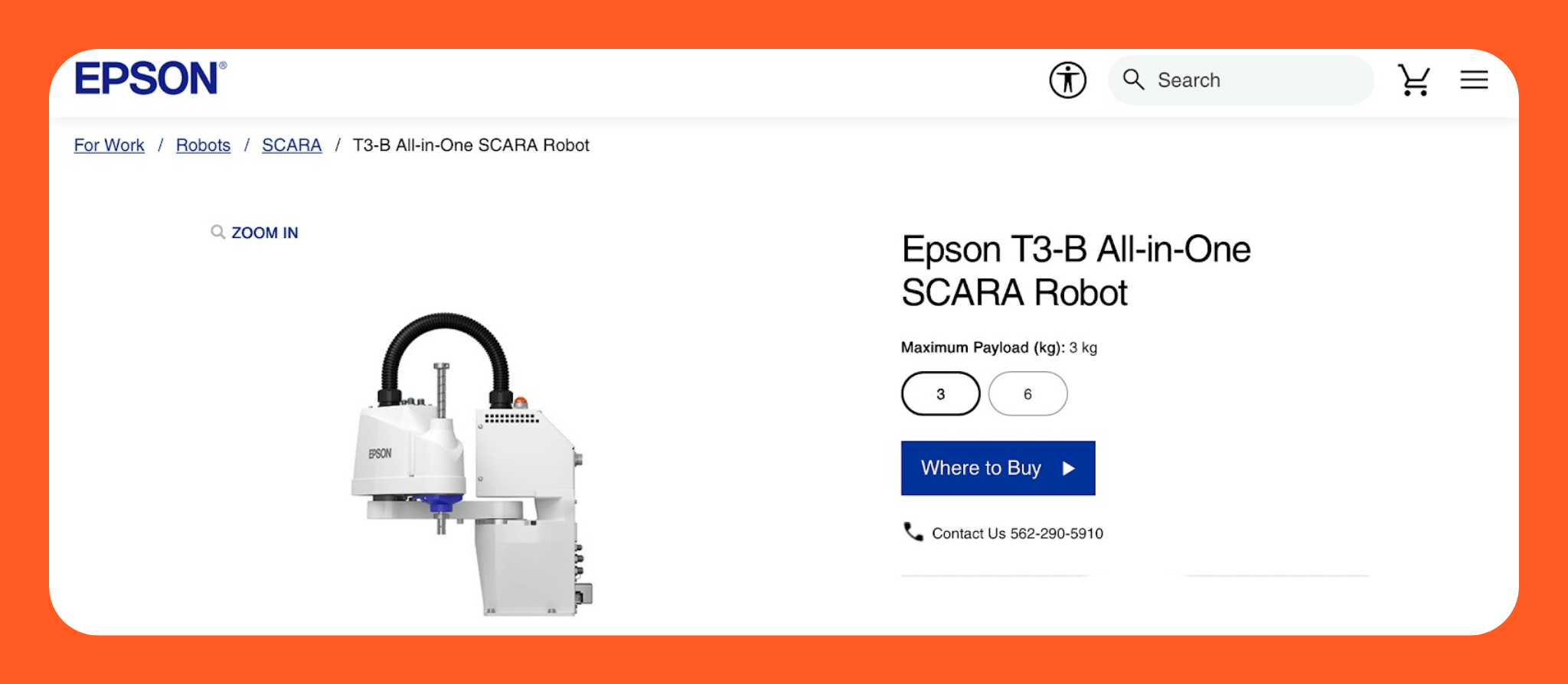
The successor to the discontinued T3, T3-B is an all‑in‑one model that features a 400 mm reach and a 3 kg payload. Engineered with a built‑in controller, power for end‑of‑arm tooling, and compatibility with both 110 V and 220 V power supplies.
It supports both Epson RC+ and the intuitive, no-code RC+ Express software, making it ideal for fast deployment in electronics, lab automation, and entry-level manufacturing setups.
Synthis T6‑B
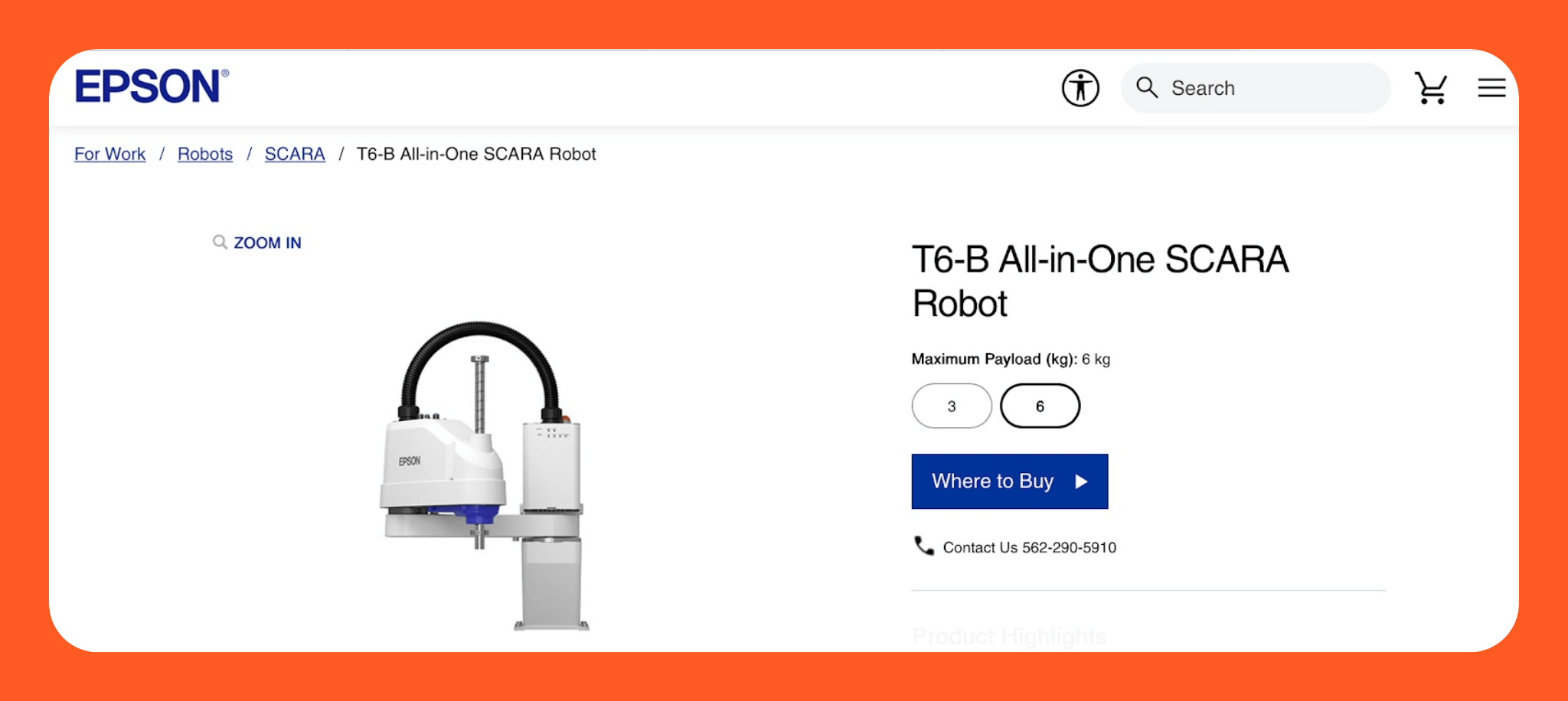
An upgraded version of the T6, the T6‑B offers a 600 mm reach, up to 6 kg payload, and the same all‑in‑one design with controller and tooling power.
It comes with Epson’s familiar software stack and is tailored for applications requiring greater reach or load, which is common in packaging, medical device assembly, and heavier small‑parts handling.
ABB
ABB positions its SCARA lineup as a balance between speed and precision, offering strong repeatability with versatile mounting options. These robots integrate well with ABB’s broader automation portfolio, making them attractive for plants already invested in ABB systems and looking to streamline control and maintenance.
IRB 920T
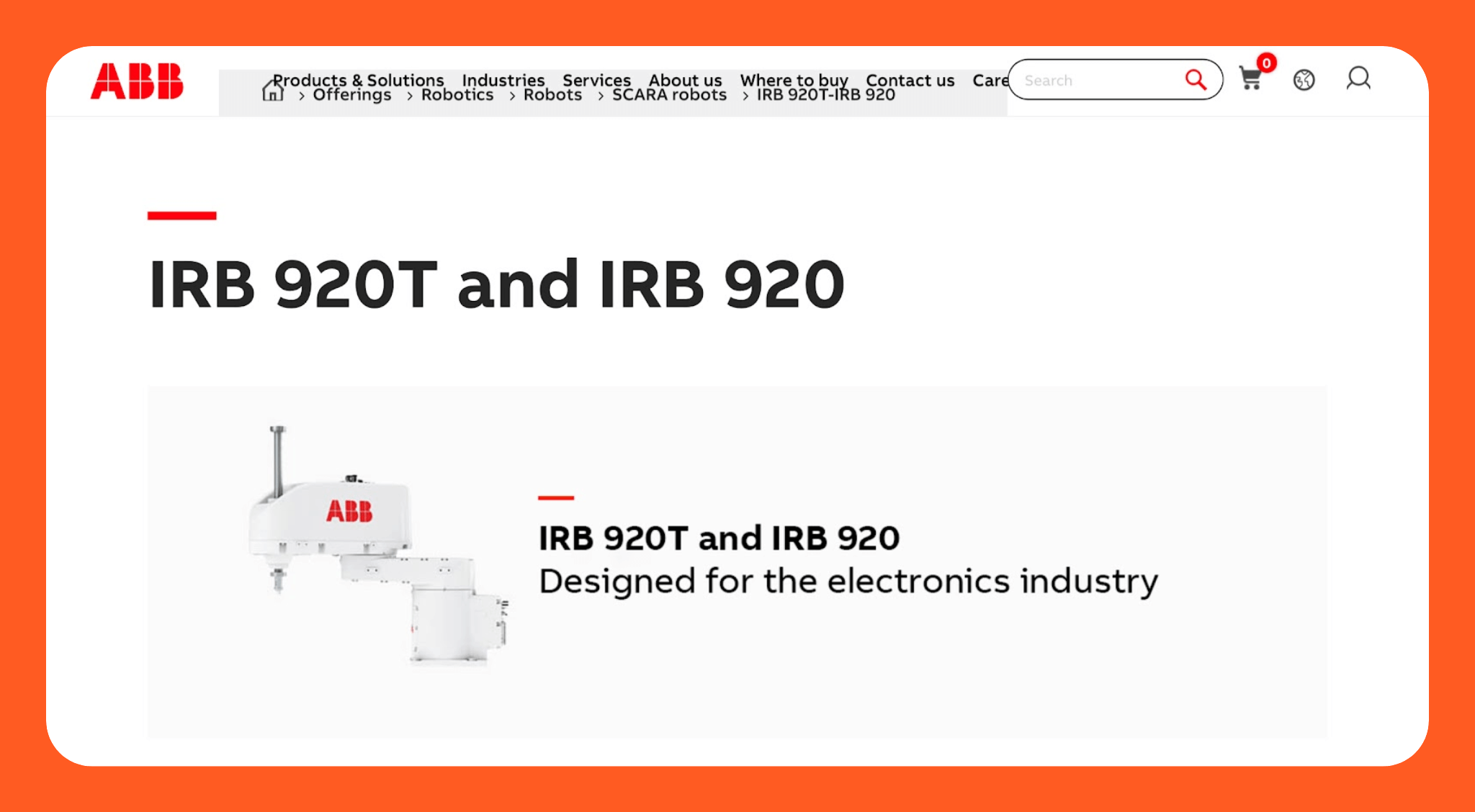
IRB 920T is a high-speed SCARA available in 450 mm and 550 mm reach versions with a 6 kg payload. Delivers industry-leading 0.29-second cycle times and ±0.01 mm repeatability, making it ideal for packaging, sorting, and small-parts assembly in high-throughput environments.
IRB 930
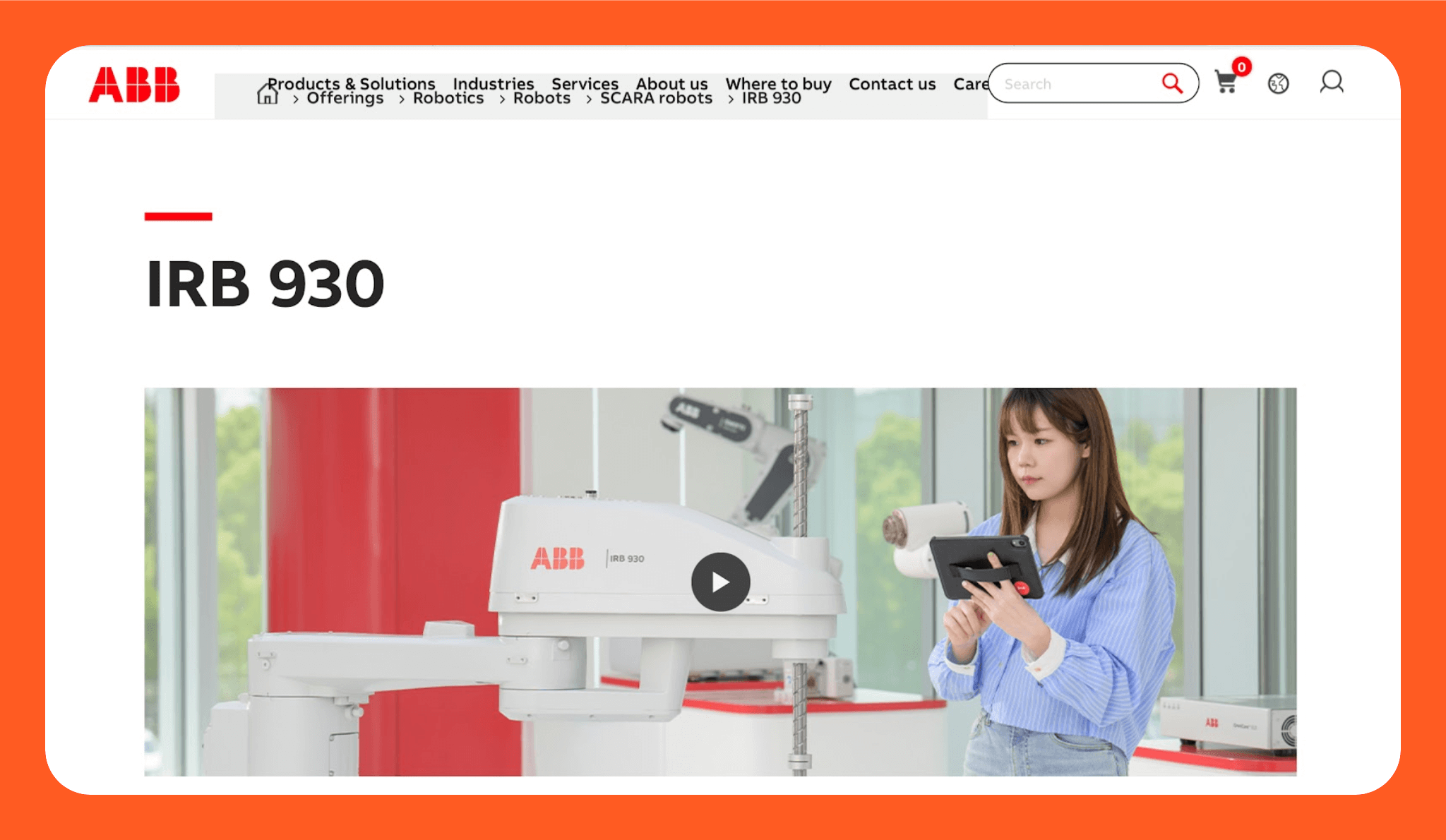
IRB 930 is the latest ABB SCARA with 12 to 22 kg payload capacity and multiple reach options (up to 1100 mm). Designed for heavier-duty applications like battery assembly, automotive component handling, and larger product packaging, while maintaining high precision.
FANUC
FANUC’s SCARA robots are designed for fast-cycle, high-volume production, often in packaging, assembly, and material handling. Known for their rugged build and global service network, they appeal to manufacturers who need high uptime, straightforward programming, and a seamless fit with existing FANUC automation equipment.
SR-12iA
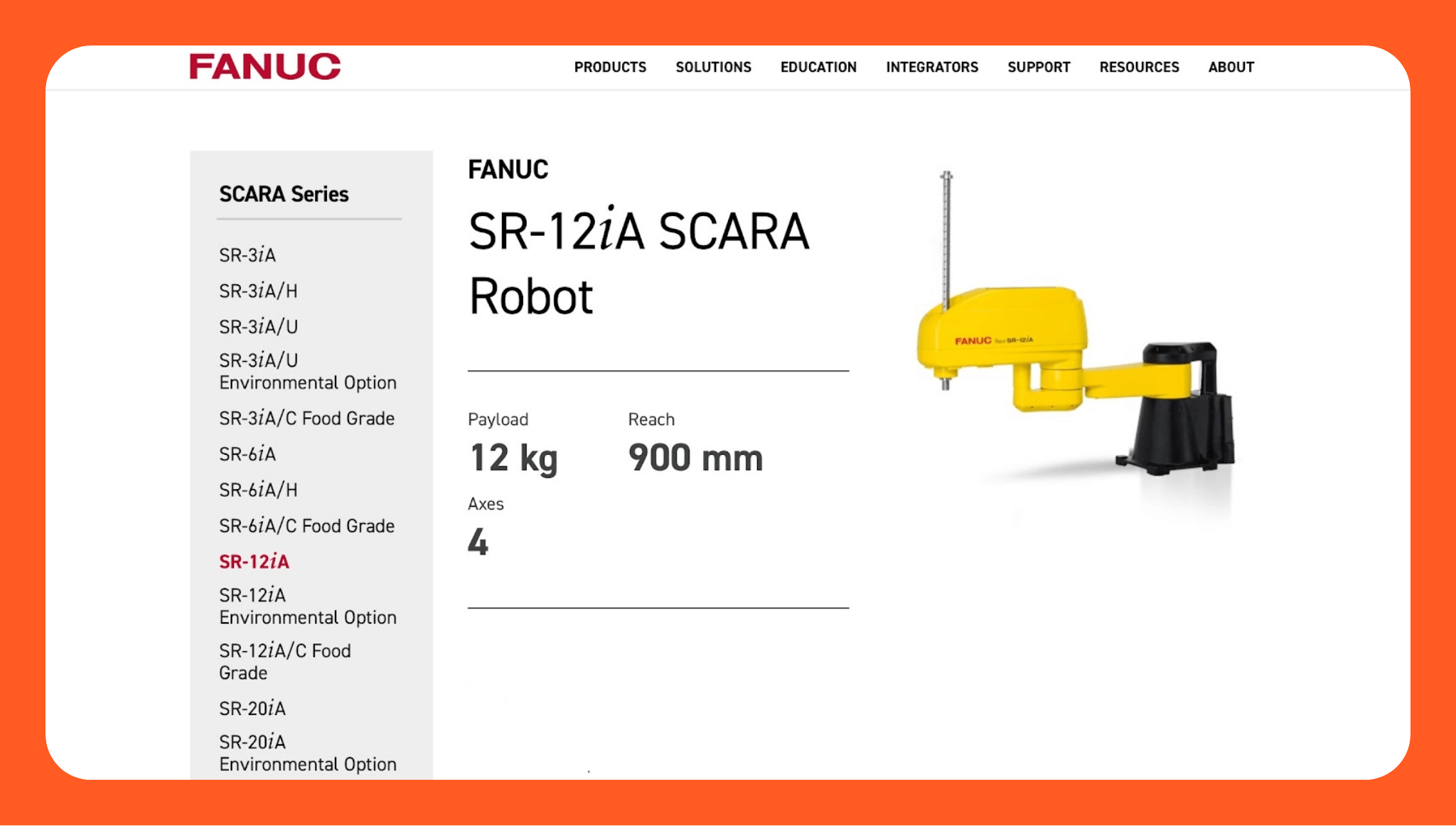
SR-12iA offers 900 mm reach, 12 kg payload, and ±0.01 mm repeatability. Ideal for machine tending, automotive sensor assembly, or material handling tasks requiring both reach and strength.
SR-20iA

SR-20iA provides 1100 mm with a 20 kg payload, making it one of the most capable SCARAs available. Best for large-part packaging, CNC loading/unloading, or palletizing where high payload and precision are equally important.
SCARA robot vs. 6-axis robot: Key differences
The table below summarizes practical tips to help you choose SCARA robot that meets your production needs while delivering a strong return on investment.
Applications that justify SCARA investment
SCARA robots are widely adopted in electronics for accurate PCB assembly, in packaging for high-speed product handling, in medical device manufacturing for contamination-free assembly, and in automotive plants for small-part production. Their compact footprint and fast cycle times make them a smart investment for industries aiming to maximize output without expanding floor space.
1. Electronics and PCB assembly
The industrial SCARA robot has become a standard in electronics manufacturing for component placement, soldering, and in-circuit testing. With repeatability often reaching ±0.01 mm, SCARAs can accurately position micro-components on dense PCB boards without damaging delicate traces.
For example, in smartphone manufacturing, a SCARA robot arm can perform thousands of placements per hour, which is significantly faster than manual operators or general-purpose robots.
The compact footprint also allows multiple SCARAs to operate in parallel, boosting line output without expanding floor space.
2. Packaging and labeling
Whether it’s loading blister packs in pharmaceuticals or placing bottles into retail cartons, robot SCARA systems are ideal for repetitive packaging work. Their high-speed horizontal motion enables faster cycle times than many 6-axis robots in flat-path jobs.
SCARAs also integrate easily with conveyors, vision systems, and automated label applicators, making them a go-to choice in food, beverage, and personal care packaging lines where uptime and accuracy directly impact profit margins.
3. Medical device production
Clean room-rated SCARA robots for sale are widely used in assembling intricate medical devices such as catheters, diagnostic cartridges, and surgical tools. These applications demand compliance with ISO clean room standards and ESD protection for sensitive components.
Though the high-performance clean room SCARAs can cost upwards of $60,000, their ability to reduce contamination risk and maintain consistent assembly quality often delivers a strong ROI.
4. Automotive small-part assembly
In the automotive supply chain, SCARAs excel at assembling smaller, high-volume components like sensors, switches, connectors, and dashboard controls. These jobs require both speed and consistent torque application.
A low-cost SCARA robot can outperform more expensive alternatives for these specific tasks, freeing up 6-axis robots for heavy-duty or multi-orientation jobs. SCARAs’ short cycle times also make them an efficient choice for Tier 2 and Tier 3 suppliers operating under tight delivery schedules.
Final thoughts: Buying tips for SCARA robots
SCARA robots remain one of the most cost-effective automation options for tasks that require speed, precision, and a compact footprint. More than equipment, SCARAs are strategic investments. When matched to the right operational needs, these robots deliver quick payback through efficiency and reliability, driving long-term competitive advantage.
These workhorses excel at high-speed, horizontal-motion tasks across electronics, packaging, medical devices, and automotive components, dominating applications where accuracy meets velocity.
SCARA robots maximize throughput while minimizing footprint, making them ideal for lean manufacturing. They integrate easily with conveyors, vision systems, and clean rooms, enabling faster deployment, simpler integration, and lower costs.
Next steps with Standard Bots’ robotic solutions
Looking to upgrade your automation game? Standard Bots’ RO1 is the perfect six-axis cobot addition to any production setup, delivering unbeatable precision and flexibility.
- Affordable and adaptable: RO1 costs $37K (list price). Get high-precision automation at half the cost of traditional robots.
- Precision and power: With a repeatability of ±0.025 mm and an 18 kg payload, RO1 handles even the most demanding jobs.
- AI-driven simplicity: Equipped with AI capabilities on par with GPT-4, RO1 integrates smoothly into complex workflows.
- Safety-first design: Machine vision and collision detection mean RO1 works safely alongside human operators.
Schedule your on-site demo with our engineers today and see how RO1 can bring AI-powered efficiency to your shop floor.
FAQs
1. How long does it take to achieve ROI on a SCARA robot investment?
The time it takes to achieve ROI on a SCARA robot investment is typically 6 to 18 months, depending on runtime, labor savings, and integration efficiency. High-speed applications like PCB assembly often recover costs faster.
2. What financing or leasing options are available for SCARA robots?
Financing or leasing options for SCARA robots typically span 12 to 60 months, depending on the vendor and model. Many suppliers offer operating leases that bundle maintenance, training, and software updates, which can reduce upfront costs.
3. Can a SCARA robot be integrated into an existing manual production line without major downtime?
A SCARA robot can be integrated into an existing manual production line without major downtime if the setup has compatible fixtures and control systems. Modern SCARA models often support plug-and-play installation.
4. Which safety certifications should I check for before buying a SCARA robot?
The safety certifications you should check for before buying a SCARA robot are ISO 10218-1 for industrial robots, CE marking for the European market, and any region-specific compliance needed for your facility.
5. What software platforms are most commonly used to program SCARA robots?
The software platforms most commonly used to program SCARA robots include brand-specific environments like Epson RC+, Yamaha RCX, and ABB RobotStudio. Some also support open languages such as Python or PLC integration.
6. Is buying a used SCARA robot a good idea for small businesses?
Buying a used SCARA robot is a good idea for small businesses if the unit is inspected, has low operating hours, and includes a warranty or service coverage. Used models can be 30 to 50% cheaper than new ones.
7. How do SCARA robots compare to 6-axis cobots in terms of maintenance costs?
SCARA robots compare favorably to 6-axis cobots in terms of maintenance costs, as their simpler mechanics and fewer moving joints make them cheaper to service. However, cobots may be more versatile for complex tasks.


