To purchase ForgeOS, contact sales@standardbots.com or request a quote via our webform.
When READY Robotics set out to solve industrial automation's accessibility problem, we didn't start from scratch. We started from some of the most forward-thinking research in human-robot collaboration ever conducted — a portfolio of five patented inventions developed at Johns Hopkins University that fundamentally reimagine how people interact with industrial robots.
In 2016, READY Robotics secured an exclusive worldwide license to this intellectual property through a technology transfer agreement with Johns Hopkins. The patents, developed by researchers Kelleher Guerin, Gregory Hager, and Sebastian Riedel, span a range of innovations that collectively form the technical backbone of our Forge operating system. Together, they represent a cohesive vision: that industrial robots should be easy to program, easy to reconfigure, and easy for non-experts to operate.
That vision is more relevant today than ever. As manufacturers face persistent labor shortages and rising demand for production flexibility, the need for intuitive automation tools has never been greater. Forge was built to meet that need, and the patents underlying it are what make it possible.
A Platform for Flexible Human-Machine Collaboration
The foundational patent in the portfolio — internally referenced as "Adjutant" — describes a platform architecture for flexible human-machine collaboration systems. Rather than requiring rigid, pre-programmed routines, this invention enables dynamic interaction between human operators and robotic systems. It provides the architectural framework that allows Forge to serve as a universal operating system across different robot brands and models, abstracting away the complexity of proprietary programming languages and interfaces. The core insight is that collaboration between humans and machines should be fluid, not fixed — and the system architecture should be designed accordingly.
Immersive Robot Control, Training, and Collaboration
A second patent addresses improved robot control, training, and collaboration within immersive virtual reality environments. This invention recognized early on that spatial, visual interfaces could dramatically lower the barrier to robot programming. Instead of requiring operators to write code or learn manufacturer-specific teach pendants, this technology enables intuitive methods for training robots on new tasks. The implications for workforce development are significant: operators can learn to program and manage robots through interfaces that feel natural rather than intimidating.
Intelligent Peripheral Management
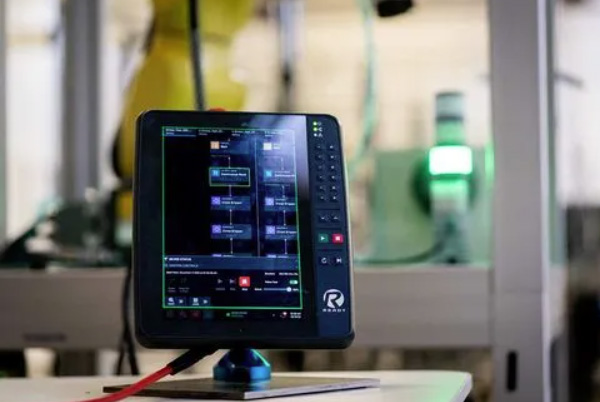
Two closely related patents cover the automatic generation of user interfaces based on peripheral connections and mobile device management of collaborative industrial robots. These inventions solve a practical problem that has long plagued automation deployments: every time you add a sensor, gripper, camera, or other peripheral to a robot cell, someone traditionally has to manually configure the software to recognize and control it. The patented technology enables Forge to automatically detect connected peripherals and generate appropriate control interfaces, dramatically reducing setup time and configuration errors. The mobile device management patent extends this capability further, allowing operators to manage collaborative robots from tablets and smartphones — bringing industrial automation into the modern era of mobile-first interfaces.
Adaptive Hardware Integration
The fifth patent in the portfolio covers a method for repeatable, rigid temporary attachment to robotic grippers. While this may sound narrowly mechanical, it addresses a critical bottleneck in flexible manufacturing. Manufacturers frequently need to swap end-of-arm tooling to handle different products or tasks. This invention enables reliable, repeatable tool changes without sacrificing the rigidity required for precision work — a key enabler of the kind of rapid reconfiguration that modern manufacturing demands.
From Research to Real-World Impact
What makes this patent portfolio distinctive is not just the individual inventions but how they work together as an integrated system. The platform architecture provides the foundation. The intuitive programming interfaces lower the barrier to entry. The peripheral management system reduces deployment complexity. And the hardware integration patent enables physical flexibility. Together, they represent a complete rethinking of how industrial automation should work.
The research that produced these patents was conducted with support from federal funding, which means the resulting technology carries a mandate to be manufactured substantially in the United States — a requirement that aligns perfectly with READY Robotics' commitment to strengthening American manufacturing capability.
As we continue to develop and expand the Forge platform, these foundational patents remain at the core of our technology strategy. They represent not just intellectual property, but a set of principles: that automation should be accessible, that robots should be easy to use, and that the future of manufacturing depends on putting powerful tools in the hands of the people who actually build things.
The work that began in the labs at Johns Hopkins continues to drive real-world impact on factory floors across the country. And we're just getting started.
To purchase ForgeOS, contact sales@standardbots.com or request a quote via our webform.
brighter future

Join thousands of creators
receiving our weekly articles.