A seam weld is a continuous weld between two overlapping materials (such as two metal sheets or cylindrical parts) along their entire length. It’s vital in automotive fuel tanks, HVAC radiators, and aerospace panels where leak resistance and strength are important.
What is a seam weld?
A seam weld is a continuous weld joint created between two overlapping materials by applying heat and pressure as the parts move beneath rotating electrodes or a welding torch. Unlike spot welding, which produces separate points, seam welding forms an unbroken line that seals the joint completely.
The result is a strong, leak-proof bond ideal for fuel tanks, pipes, drums, radiators, and other components that must withstand pressure or exposure to fluids. In modern manufacturing, seam welds are also common in automotive body panels, HVAC ducts, and powertrain systems, where durability and uniformity are important.
Robotic seam welders and automatic seam welding systems maintain consistent current, force, and travel speed, and ensure every weld seam meets the same quality standard.
Standard Bots makes this process accessible through full-stack robotic integration that combines precision hardware with intuitive software control, helping manufacturers scale production without compromising strength or quality.
Why should you automate seam welds?
You should automate seam welds to improve speed, precision, and repeatability across every joint. It delivers measurable advantages such as higher accuracy, faster throughput, improved safety, and complete process traceability.
- Higher throughput: Automated seam welding systems run continuously, cutting downtime between welds and significantly improving productivity.
- Safer and easier work environments: Robots handle repetitive, high-temperature operations, reducing fatigue and exposure for welders.
- Built-in traceability: Every weld cycle logs current, voltage, and force data for quality checks and compliance reports.
- Enhanced quality and strength: Tightly controlled parameters produce deeper penetration and cleaner seams, which are essential for fuel tanks, radiators, and powertrain parts.
- Improved consistency and accuracy: Robotic seam welders follow precise paths, keeping heat and speed steady along every joint. This ensures strong, defect-free weld seams and eliminates variations common in manual welding.
The global seam welding machine market is projected to reach $1.71 billion by 2029, growing steadily at 4.7% annually. With automation, manufacturers can produce uniform welded seams faster, safer, and with precision that manual methods can’t match.
When automation may not be ideal
Automation may not be ideal in situations where production volumes, part shapes, or setup budgets make manual or hybrid welding more practical. Some operations benefit more from operator control, especially when flexibility and frequent changeovers are required.
- High setup cost: Robotic seam welding systems require dedicated tooling, rollers, and integration, making them more practical for high-volume production rather than short-run or prototype work.
- Limited flexibility: Automation performs best on repeatable geometries. Complex or irregular weld seams, like internal joints or curved assemblies, often need human guidance for fine adjustments.
- Maintenance requirements: Automated cells rely on calibrated sensors, rollers, and current controls. Regular maintenance is necessary to sustain accuracy and seam quality.
- Nonlinear or hard-to-access seams: Some shapes can challenge the reach or alignment of robotic arms, requiring hybrid setups where operators assist or pre-position parts.
The seam welding process
Seam welding joins two overlapping materials by applying heat and pressure as they move beneath rotating electrodes or a torch. The goal is to create one continuous, uniform joint rather than individual weld spots.
- Clamping: Two sheets or cylindrical parts are aligned and pressed together under force.
- Current or heat application: Electrical current, friction, or an arc generates heat at the contact point.
- Continuous movement: The electrodes or rollers move along the joint, fusing the materials into a single, solid seam.
- Cooling and solidification: As the heat source moves forward, the previous section cools and hardens, forming a durable, airtight bond.
Most factories use resistance seam welding for thin steel. Laser, friction, or arc methods are best for thicker sections or specialty alloys. The quality of each welded seam depends on tight control of pressure, current, and timing. Even slight variations can affect seam uniformity or penetration depth.
That’s where automation adds real value. Robotic systems maintain these parameters precisely, ensuring repeatable, high-quality welds across thousands of components.
Applications of seam welding automation
Applications of seam welding automation include automotive body and fuel tanks, HVAC ducts and heat exchangers, aerospace and shipbuilding structures, pipes, tubes, and powertrain systems, and drums, cans, and industrial enclosures.
Automotive body manufacturing and fuel tanks
In automotive production, seam welding joins components that must remain completely sealed under vibration and stress. The process delivers gas- and fluid-tight seams and has been an industry standard for years because it can handle high-volume, repeatable parts.
A single robotic seam-welding cell can handle multiple vehicle models by adjusting parameters automatically, cutting downtime, and improving throughput.
Systems from Standard Bots are designed precisely for this type of integration. They combine precise motion control, weld tracking, and in-process data logging into one unified setup.
HVAC ducts, radiators, and heat exchangers
The HVAC sector depends on continuous seams to keep airflow and coolant circulation efficient. Radiators, ducts, and exchangers require airtight welds along thin aluminum or galvanized sheets, where manual inconsistency can lead to energy loss or system failure.
Automated resistance seam welding ensures that pressure and temperature remain stable across long welds, delivering cleaner, more uniform joints. Automation raises line speeds and maintains airtight seals that pass leak tests for radiators and ducts. It reduces operator strain and helps maintain steady output even during multi-shift operations.
Aerospace and shipbuilding structures
Seam welding is used for aircraft fuel tanks, fuselage panels, and marine hulls where joints must remain strong under extreme pressure or temperature changes. Automated systems maintain weld penetration and bead uniformity across large sections, limiting distortion in lightweight materials such as aluminum and titanium.
Real-time monitoring of parameters like current and voltage allows aerospace manufacturers to meet documentation and certification standards. Automation has also helped shipyards speed up hull fabrication while maintaining watertight integrity across large weld runs.
Pipes, tubes, and powertrain systems
Longitudinal seam welding is standard in pipe and tube manufacturing for oil, gas, and hydraulic applications. Here, precision and weld strength determine how well pipes hold up under pressure cycles.
Automated resistance and submerged arc seam welders maintain constant travel speed and heat input, producing continuous, high-strength joints with minimal distortion.
In automotive powertrains and hydraulic systems, automation enables consistent internal welds that prevent leaks and maintain flow efficiency. The ability to record process parameters for each weld also ensures traceability for quality assurance.
Drums, cans, and industrial enclosures
Metal packaging and container fabrication rely heavily on seam welding to ensure leak-proof seals for products such as paint drums, oil cans, and chemical barrels. Automated seam welders operate at high speed and produce hundreds of uniform welds per hour, while maintaining airtight seals.
The process ensures that every welded seam passes durability and corrosion-resistance tests. By pairing these seam welders with robotic material handling, manufacturers can move from manual feeding to fully automated lines, reducing cycle time and improving safety.
Robotic welding with Standard Bots
Standard Bots offers a complete approach to robotic welding automation with solutions that combine advanced hardware, intuitive software, and real-time control. Designed for both small shops and large plants, its robots simplify setup, improve weld consistency, and reduce integration time.

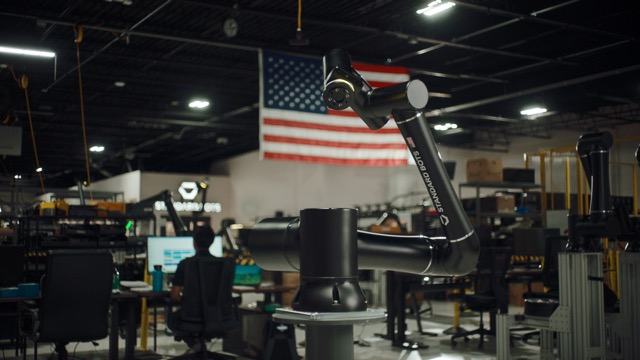
Standard Bots Thor handles heavier assemblies with a 30 kg payload and 2 m reach, while maintaining ±0.025 mm repeatability. It’s well-suited for long or complex seam welds in automotive frames, ship components, or large enclosures. Its strong design, combined with smart motion control, allows continuous, high-speed operation with consistent results.

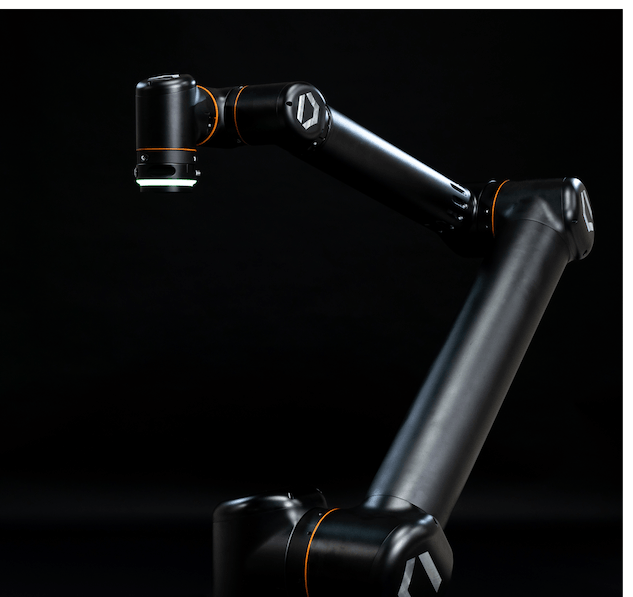
Standard Bots Core is a six-axis cobot engineered for precision tasks, which delivers ±0.025 mm repeatability with a 1.3 m reach and an 18 kg payload. It’s ideal for high-accuracy seam welding on smaller assemblies such as HVAC panels, radiators, and fuel tanks.
Manual vs. automated seam welding
Both manual and automated seam welding aim for strong, continuous joints. But they differ greatly in consistency, speed, and scalability. Manual welding depends on operator control and experience, while automation ensures precision through programmable motion and process monitoring.
In practice, many facilities use a hybrid approach, where operators oversee robotic cells for part setup and inspection while robots handle the welding itself. This balance combines human judgment with automation precision.
Manufacturers integrating robotic systems from Standard Bots can easily transition from manual setups to automated seam welding and maintain accuracy while cutting downtime and rework.
How to implement automated seam welding
Implementing automated seam welding begins with assessing part design, selecting the right process, integrating smart tracking systems, and gradually scaling through robotic integration.
- Evaluate part design and geometry: Start by checking whether your parts are suitable for automation. Seam welding performs best on simple, repeatable shapes like flat sheets, cylinders, and tubes.
- Select the right welding process: Choose a process that fits your material and workload. Resistance seam welding suits thin steel or aluminum sheets. Laser seam welding suits fuel tanks or aircraft panels. Arc or friction seam welding works best for thicker or mixed metals.
- Integrate seam tracking and vision systems: Seam-tracking sensors or laser-based systems detect the exact joint path and automatically adjust the electrode or torch position. Vision systems enhance precision on curved or large parts, maintaining uniform seams and reducing the need for rework.
- Start with a pilot setup: Before scaling across the entire line, begin with a pilot cell to fine-tune parameters like pressure, current, and travel speed. This controlled setup helps confirm weld integrity and train operators to manage automated cells confidently.
- Scale through robotic integration: When moving to full production, connect seam welders to monitoring and quality control systems. Recording voltage, pressure, and current for every weld creates full traceability and supports predictive maintenance.
Summing up
Seam welding has become an essential process for industries that need reliable, airtight joints. Automation transforms it from a manual, skill-dependent task into a precise and repeatable operation that improves strength, speed, and safety.
Though setup costs can be high, the long-term gains in consistency and throughput easily justify the investment. Manufacturers that begin with pilot systems and scale gradually see better control over quality and downtime. Automated seam welding is now a key part of modern, data-driven production built for accuracy and efficiency.
Next steps with Standard Bots’ robotic solutions
Looking to automate your seam welding operations? Standard Bots Thor is built for big jobs, while Core is the perfect six-axis cobot addition to any welding setup, delivering unbeatable precision and flexibility.
- Affordable and adaptable: Core costs $37k, and Thor lists at $49.5k. Get high-precision welding automation at half the cost of comparable robots.
- Perfected precision: With a repeatability of ±0.025 mm, both Core and Thor ensure smooth, consistent weld seams.
- Real collaborative power: Core’s 18 kg payload suits precision welding tasks, while Thor’s 30 kg payload manages heavy-duty fabrication.
- No-code simplicity: Our intuitive, no-code app makes it easy to teach Standard Bots robots to do everyday tasks. So, Core and Thor integrate smoothly with welding operations for advanced automation.
- AI-driven models: For complex, high-variance, and unpredictable tasks that are otherwise impossible to automate today, Standard Bots robots learn through our AI-driven vision-to-action models, similar to how full self-driving works.
- Safety-first design: Machine vision and collision detection mean Core and Thor work safely alongside human operators.
Schedule your on-site demo with our engineers today and see how Standard Bots Core and Thor can bring AI-powered accuracy and increased productivity to your shop floor.
FAQs
1. What is a seam weld?
A seam weld is a continuous weld joint that fuses two overlapping metal parts along their length. It creates an airtight and watertight seal, making it ideal for applications like automotive fuel tanks, HVAC ducts, and pipes where leak resistance and strength are essential.
2. How does seam welding differ from spot welding?
Seam welding differs from spot welding because it produces one continuous weld line instead of multiple individual weld spots. This makes seam welding better suited for components requiring sealed joints, while spot welding is preferred for fast, point-based sheet joining.
3. What materials can be joined using seam welding?
Materials that can be joined using seam welding include steel, stainless steel, aluminum, and copper alloys. The specific method depends on the material’s thickness, conductivity, and application requirements.
4. What are the advantages of automated seam welding?
The advantages of automated seam welding include higher precision, faster production, consistent weld quality, and improved safety. Automated systems also track voltage, current, and pressure for each seam, allowing full traceability and easier quality control.
5. When should I use manual seam welding instead of automation?
Manual seam welding should be used instead of automation when working on low-volume, irregular, or custom components. It gives welders flexibility to adjust torch angle, speed, and heat in real time.
6. How much does an automatic seam welder cost in 2025?
An automatic seam welder in 2025 typically costs between $25,000 and $80,000, depending on size, capacity, and level of automation. Fully robotic systems with integrated vision tracking or data monitoring can exceed this range based on customization and production volume.
brighter future

Join thousands of creators
receiving our weekly articles.